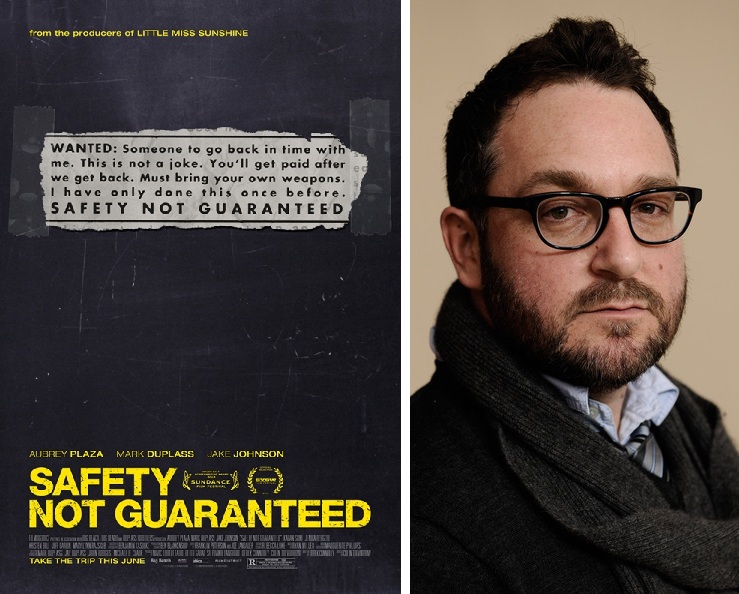
 Mark Duplass Month (including Your Sister’s Sister and People Like Us) continues with Safety Not Guaranteed, a small comedy that may have a dose of “science fiction” or just “crazy delusion.”
(Read my interview with Your Sister’s Sister writer-director Lynn Shelton.)
The tremendously entertaining film from writer Derek Connolly and first-time director Colin Tervorrow, is inspired by the real 1997 Backwoods Home Magazine classified ad that became an Internet meme:
“WANTED: Somebody to go back in time with me. This is not a joke. You’ll get paid after we get back. Must bring your own weapons. Safety not guaranteed. I have only done this once before.”
Duplass stars as Kenneth, the eccentric, backwoods would-be inventor and time traveler, with Aubrey Plaza (Parks and Recreation, Funny People, Scott Pilgrim Vs. the World), Jake M. Johnson (New Girl, 21 Jump Street), and newcomer Karan Soni as a misfit team of journalists and interns hoping to get to the bottom of Kenneth’s claims.
The comedic film is a wonderfully oddball mix of low-key fantasy and farce, but centers on a truly affecting human story about lonely souls and past regrets. Unfortunately I enjoyed Safety so much that when I sat down with director Trevorrow a few weeks ago in Chicago, I’m afraid I did a bit of a “Chris Farley,” spending a lot of my time just gushing to him about how much I liked his film.
Still, we managed to talk about what he calls the “low-sci-fi” film movement; his love of ’80s fantasy films; how to turn caricatures into characters; and the “scrappy” authentic, aesthetic value of shooting “fast and cheap.”
____
Safety Not Guaranteed is playing at select theaters across the country.
____
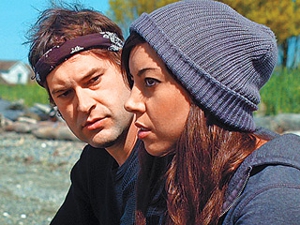 I’m becoming such a fan of the “alt” sci-fi film movement, with recent lower-budget works like Another Earth, The Sound of My Voice, and Beasts of the Southern Wild. Your film slides in there with them.
Colin Trevorrow: We call it “low sci-fi.” I’m going to try to coin that one. You’ll be the first that’s ever heard it. We didn’t think of it so much as a genre, but as a way to tell an emotional, character-based story in the context of a sci-fi comedy. I think it’s easier to get people to go along on that ride with you if there’s a fun way in.
You’ve mentioned your love of the ‘80s “Amblin’” style sci-fi and fantasy, the Spielberg-produced movies like Goonies and Back to the Future. With its mix of realism and possible fantasy, does Safety have roots in that childhood genre?
Trevorrow: That’s where I grew up, it’s what I know, it’s everything I watched. I was born in 1976 so I was 4 to 14 during the 80’s, which is the prime zone for those movies. And it is so much a part of what crafted me as both a person and a story teller that I think it’s impossible for it not to influence what I do and where my instincts are.
I wanted to bring in some very disparate points of view to counter that so it didn’t go too far down that road of being a Spielberg/Amblin film. So you bring in Mark Duplass and his world, and Aubrey Plaza, and then my writing partner Derek Connolly has a very different point of view, he’s much darker than I am. You end up getting is this movie. It has my Amblin’ side. It has some dark stuff from Derek. It has this humanistic side from Mark. It has this very cynical, disaffected side from Aubrey’s character as she is changing. So really the goal is which things can we combine to make an interesting, new cocktail?
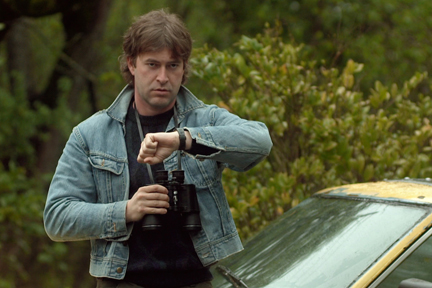 You’ve written several as-yet unproduced scripts with Derek, and mentioned his sensibilities lean a little darker than yours. But unlike your other scripts, you did not write this one at all, so how did you balance out your different sensibilities for Safety?
Trevorrow: We have a natural balance as writers. My skill set is much more structural and architectural in my writing. Derek’s strengths are in inspiration and character and irreverence–these things that are very, very difficult for anyone to manufacture. Going in we knew I’d be directing, so we wanted to make sure to keep the script entirely with Derek and his tone and point of view. With me directing Derek’s scripts, you’re getting a combination of both of our instincts, it’s just that they are coming through different avenues.
Everyone in Safety starts out as a familiar stereotype: Jake M. Johnson the “cool,” kinda D-baggy Lothario; Aubrey Plaza as basically the same introverted, arms-length character we’ve seen in Parks and Recreation, and Karan Soni as the seemingly stereotypical nerdy South-Asian guy. And it would have been very easy to present Duplass’ Kenneth as a mockable, mulleted, deluded rube. But as the film progresses, they all become fuller, more rounded and realistic.
Trevorrow: I felt that there were certain archetypal attributes to all of these characters and I felt like the only way we could pull that off and keep the tone that I wanted is if we really focus on presenting a caricature and then turning it into a character. I think that’s part of what makes the movie slowly pull you in. You know, the film’s nice and light at the start, and you’re having fun with people who are very familiar to you. And then those people start to do things that are unfamiliar and surprising.
We also have Kenneth, who as the movie starts you assume he is going to be a caricature, then you meet him and he is very real, very honest. He is talking about time travel, but Mark has such a grounded presence. It’s very natural and we were able to flip that and Kenneth slowly grows richer over the course of the movie.
 There’s a wonderful quiet moment later with Aubrey and Mark, where she does this little thing with putting her hands up to her chin, and you as the viewer are kind of shocked—it doesn’t feel like an Aubrey Plaza gesture, but it feels so honest as her character is becoming less guarded.
Trevorrow: And there’s an earlier moment where she smiles, and you’re like “Whoa, that’s the first time I’ve seen Aubrey Plaza smile.” It’s momentous.
I also have to add how much I love Jake M. Johnson—I singled him out last year in No Strings Attached and Ceremony and wrote, “Keep an eye out for this guy.” Then New Girl comes along and everyone is discovering him. I end up with that mixed excitement for him and his talent, but…
Trevorrow: It’s like that cool indie rock band that nobody knows about, but has now been discovered.
Exactly! Also, I really love the visual authenticity of the film—everything looks real, feels physically real and that adds to the emotional verisimilitude of these characters that could have easily ended up as caricatures in a cartoonish comedy. Does it help that you shot the film, as you’ve said, fast and cheap?
Trevorrow: We had to find real, practical locations for everything. That’s a real, old truck that happened to be on the site that the time travel machine was going to be on, and that’s a real, old house that had been untouched for 20 years and the moss had grown over it. A lot of the furniture was left in there from this man’s mother who had died, and he had kept it pristine. And so there was like a true layer of dust on everything that we were using–it’s not manufactured authenticity.
 And for me, the biggest benefit from moving quickly was that actors weren’t off in trailers all day then coming in and working for 20 minutes then leaving and playing X-box.
The actors were there the entire time and constantly in their characters and constantly working, so there is immediacy in those performances that I think you can feel onscreen–we always had to be focused one 100% of the time. It was 12 hours then we would sleep whenever we can and then we would go for another 12 hours.
I miss that feeling from directors who’ve gone on to make bigger and bigger films. It’s one of the things I love the most about films like Jaws, and even Raiders and Star Wars. They feel…
Trevorrow: Scrappy!
Yes, scrappy! I really hope this film catapults you to the next level because I want to see more of your ideas on film, but I hope there’s a way to preserve some of that original scrappiness.
Trevorrow: What’s cool is that in the projects I’m talking about doing, the studios are very interested in maintaining that. That makes me happy. I’m developing a larger studio project and a mid-range studio project budget-wise, but regardless of the budget, I make it very clear that these are going to feel real, because that’s just what I want to do.
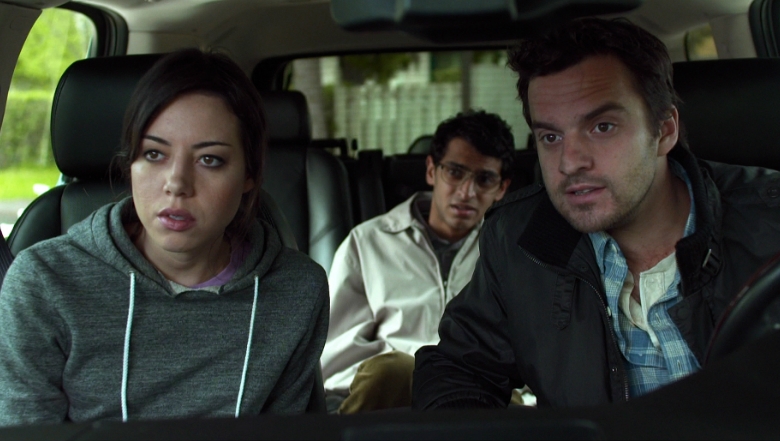 My style is not flashy. We don’t have a lot of big fancy cameras moves in this movie. I think Spike Jonze had this wonderful style in Where the Wild Things Are before they went to the island. That home stuff in Where the Wild Things Are was one of my favorite 10-minute bits of film in recent years because it felt so real.
Eternal Sunshine of the Spotless Mind, also–for me that’s like the first low sci-fi movie, even though it’s an expensive film dollar-wise. Tonally it’s emotional time travel, and it’s also shot in a way that feels absolutely naturalistic and real. It’s almost ugly in a beautiful way at times. I love it.
The film I really want to do next is a post traumatic stress drama disguised as a bad ass sci-fi action movie. I think there is a way to address that issue and have a character be a hero and overcome a lot of those struggles in a context that is crazy entertaining and a lot of fun at the same time. So that’s always going to be the goal, is to make sure that these movies are about something.
 Hammer & Thump
SNG totally makes up for Prometheus 🙂
What a totally pleasant surprise. And I am glad I waited to read your review after I saw the movie.
Did you through this in the interview “emotional verisimilitude ” to make up for your gushing??? 😉 I am glad you gushed maybe will inspire them to make more of these gems.
I would love someone to comment on the whole time travel issue. When the character Kenneth said “she must be alive because we already went back”. But they hadn’t yet so how could have the future been altered when they had not gone back yet. I know he described time to be more like a triangle, but a triangle still has a fixed point in time. Would have loved if you had asked about the Time Travel Consultant person who received credit. Were they a real person or just a gag?
LikeLike
Jen, the “Time Travel Consultant” on the film is John Silveira (in the film he’s also the older man who first shows up at the post ofice boxes, before Kenneth) — he’s the actual editor at Backwoods Magazine who, in 1997, wrote the original “Safety not guaranteed” classified ad as a joke to fill up space. So the film credit is BOTH real AND a gag — sort of like the film itself.
It’s been well over a month since I saw the film, so I’m fuzzy on details, but as I recall, Kenneth’s comment about the woman still being alive today means he ASSUMES he and Darius WILL successfully go back in time in the near future and SAVE her. So he’s saying not only is she alive because they went back, but her being alive is PROOF that they WILL go back.
However, of course, all this is fraught with double meanings. Her being alive could also be seen as proof that Kenneth is mentally unstable, that he has concocted the entire accident in the past as a delusion to help him block out his youthful behavior and the accident (which was real, but may not have actually killed her — that might have just been a story he told himself to hide the banality of his actions within a grand “tragedy.”)
***Now MAJOR SPOILER ALERT!!!***: The ending of the film you saw was NOT the original ending. In the original ending the time machine does NOT work, and it seems clear Kenneth is delusional and unhinged. (Which would mean that of course the girl from his youth never actually died in the car accident, which is why she’s still alive today.) As Colin described it to me, the original ending was obviously much more bittersweet (and made the film NOT “science fiction”), but that Kenneth and Darius did still move toward some sort of awkward, damaged, honest relationship, even after she thought he was a nutcase. He also hinted that in the original ending there was still something found in the metal box that would raise questions about whether Kenneth had actually gone back in time (in which case it was just that the time machine didn’t work YET).
That ending was shot and edited, and might have been shown at Sundance (I’m not sure about that), but then Colin and the producers decided they wanted a more upbeat, heartwarming “Amblin” ending (which is why we were talking about ’80s Spielberg films so much — I had to cut out a lot of that conversation because it related directly to the ending, which it’s best to not know anything about what happens). His writing partner Derek HATED the new ending — as Colin said, Derek is a little darker and more cynical than Colin. However, Colin finally sold Derek on the new, “happier” ending in which the time machine works by telling Derek, “Well, they could both DIE horribly in the space-time continuum when the time machine disappears–we don’t know!” And that grim possibility sold Derek enough on the new ending.
LikeLike