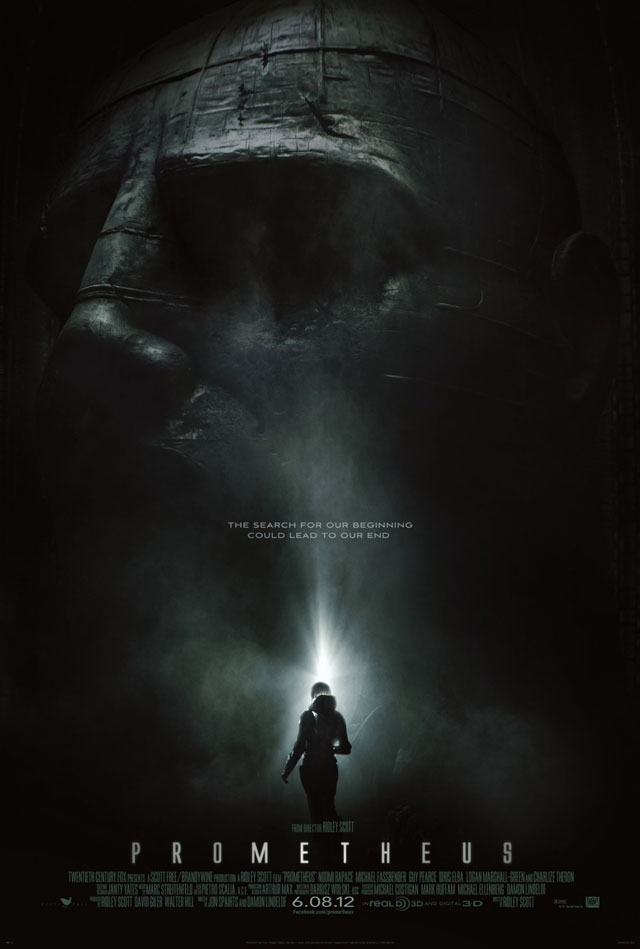
 A third of the way into director Ridley Scott’s Prometheus, I wrote in my notes, “This is dang-near perfect—everything you’d want from a summer sci-fi thriller with cosmic aspirations!”
Two-thirds through, I wrote, “Hey, what the hell happened to that terrific, summer sci-fi thriller I was watching?”
Prometheus opens millions of years in the past, with the first shudder and swirl of life on Earth—the primordial scene burns with a cold ethereal light and thematic heft that’s darkly intoxicating. There’s a low, ominous hum in the gloaming, as if you held your ear up to the universe and felt something listening back.
Eventually this Terrance-Malick-on-‘roids vibe gives way to more conventional storytelling as the film jumps 80 years into our future. Two scruffy archeologists (Noomi Rapace and Logan Marshall-Green) find Chariot of the Gods-like markings from ancient humans that lay out a primitive star map.
Soon they and other scientists are off on a corporate-funded, deep-space mission aboard the exploration ship Prometheus to find humankind’s extra-terrestrial “Engineers”—our fathers who art in the heavens. Scott’s sprawling vistas on Earth and beyond (beautifully lensed by Dark City’s Dariusz Wolski) are backdrops to what the film considers The Big Questions: Where do we come from? Why are we here? What happens when we die?
(Never mind these Big Ideas aren’t far beyond the level of high-school notebook doodling—for anyone willing to listen, they’ve pretty much been answered by evolutionary biologists and Monty Python’s Meaning of Life. Still, they’re good enough for a summer sci-fi flick’s pseudo-intellectual springboard.)
 Once the explorers follow the map to a desolate alien planet, things feel more familiar. Scott, Twentieth Century Fox, and writer Damon Lindelof spent the past winter playing coy about whether or not Prometheus is an Alien “prequel,” and later I’ll argue it both is and isn’t.
But the new film does follow the original Alien’s narrative structure and beats – the landing, the exploration, the strange discoveries in an otherworldly storage building, the conflicting and sometimes nefarious crew agendas, and of course the running afoul of nightmarish goo.
Yes, Alien visual cues start popping up, soon followed by the aliens themselves (or their genetic cousins). Most of them, however, do not match up exactly with the face-huggers, chest-bursters, and oblong-headed adult aliens with which we’re familiar. Still, biological similarities remain—though he was not a designer on the new film, once again the various stages of critter growth follow H.R Giger’s disconcerting psycho-sexual visuals.
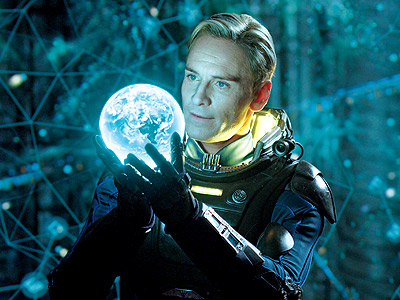
In addition to Rapace and Marshall-Green, the Prometheus cargo list sports genuine acting talent. Company Ice Queen Charlize Theron is in charge, her ramrod corporate climber an easy martinet. And as the ship’s captain, the great Idris Elba provides blue-collar, no-nonsense honor. But the film’s best thespianing is from Michael Fassbender as David, the now-obligatory android. Smoothly carved with a crystal-clear, blue-eyed lack of soul, this is not Michelangelo’s David but Mitt Romney’s: The Corporation as Person (by way of young Peter O’Toole, as David spends his free time studying Lawrence of Arabia for cues on how to act “human” and style his bright blond hair).
 Unfortunately, the film’s plot centers on Rapace’s character, and the Swedish-Spanish actress comes up flat and reactionary, lacking spark or fire, and unable for the second time in a year (after Sherlock Holmes: A Game of Shadows) to find her way from under the limitations of tent-pole franchise making.
(Rapace’s career-making performances in the Swedish Lizbeth Salander films were much more inward-turning—to make her way in Hollywood, she’d do well to lay off the big stuff and find smaller films that grant her time and space to create real characters.)
The rest of the crew are a mix of comic relief and alien chow—we don’t care much even when a major one bites it, since they’ve all been slopped out with broad strokes and dotted with signifying “details.” (This one plays an antique squeezebox, these two have a running bet, this one has a funny beard…)
There’s plenty of the horrific here, but Prometheus is not a horror film—it shares Alien’s trappings and sense of impending doom, but not the original’s claustrophobic suspense or haunted-house terrors. The film’s R rating is not so much for blood, gore, nudity, or language–relative to its genre peers, there isn’t all that much of it here. (In fact many editing decisions appear to be aiming for an elusive PG-13.) Rather the final R is here for the unsettling invasiveness of the alien violence—in keeping with the original’s primal themes of sex and death, the creepy crawlers literally get under your skin.
 So is this a prequel to Alien? Absolutely yes, and kinda no. It directly sets the stage for the arrival 30 years later of Ripley and the Nostromo and the start of the full-blown Alien franchise. But by its end, Prometheus is headed in a different direction, one clearly aimed at multiple non-Alien sequels. It may still have slimy monsters in its dark corners, but its mind is on more than simple survival.
And yet, for all those big ideas about humanity’s origins and the attempts at 2001 and Solaris-style mystique, Prometheus’ entrancing mists eventually give way to familiar green goop and oily gunk. By its third act the film’s once-solid narrative fragments, and characters are tossed willy nilly by plot necessities, not the earlier goings’ existential poetics. (Why is this character suddenly over here in this part of the ship? Um, because she needs to be for the finale…) We end up with the usual gruesome sci-fi deaths as the film’s internal logic melts down as if drenched in acidic alien blood.
(*Speaking of story contrivances, we’ll Spoiler-talk in the comments below about the biggest head-scratcher: Why the film makers intentionally avoid sticking the Single Visual Plot-Point Landing needed to set up Alien.)
The first half of Prometheus has bravado grandeur. (Marc Streitenfel’s score sports heroic Copland-ian horns, though less would have been much more when it comes to the increasingly intrusive musical cues.) Ships of size and weight move heavily through expanses of space and landscape, and the film often looks and feels vast, open to cosmic possibilities.
 But ultimately Prometheus doesn’t get anywhere with its deep ideas. Scott, Lindelof, and co-writer Jon Spaihts can’t bring it all together in the end, narrowing their sights on a creature-feature parade that slops aside the larger themes and aesthetics.
Alien and sci-fi fans will find Prometheus is about half the film they sought, though that half is still well worth seeing. Blinking our way back into the present-day, we feel a hollow absence only because the film set its frame so enticingly wide.
 Hammer & Thump
SPOILERS
Not sure what shot you mean leading it to Alien.
But this wasn’t the same planet that’s in Alien. That was LV426. and according to Scott that particular Ship and Jockey had been there for a hundred thousand years or so. While the events on LV233 in Prometheus were 2000 years before our fearless crew arrives.
So our favorite xeno species has been “engineered” for quite some time it would seem. Perhaps yet another ancient case of a batch of interplanetary species undo, went all Sarah Palin on them.
LikeLike
I saw that this morning when I did some Interweb poking around — that yes, they ARE two different planets, two different Engineer spaceships, two different Space Jockeys. All of which is SO much WORSE. That’s just TERRIBLE storytelling and film making.
I’m not an Alien fanboy, but I am pretty familiar with the franchise, and I’m a kinda astute viewer of film both genre and otherwise, and this ENTIRE film is set up to SEEM as if we’re seeing the same planet as in ALIEN. I’m sure someone at some point in PROMETHEUS mentioned the name/number of this new planet, but honestly I didn’t have my handy numerical star chart handy at the screening.
To do all this set up, to show us all this that is so visually connected to ALIEN and then say, “Oh, yeah, by the way, it’s a DIFFERENT planet” is just ridiculous film storytelling. It’d be like Lucas making the prequels and at the end of SITH having Padme name the twins “Lance” and “Laura” and then turn to the viewer and say, “Oh, sorry, this was a DIFFERENT ‘Anakin Skywalker’ and ‘Darth Vader’ we’ve been following.”
I’m sorry, that’s AWFUL film making — viewers should not have to read every interview with Ridley Scott or spend hours skimming fan-boy forums in order to get the right information to fully understand the film itself. It’s the FILM’S job to tell a story that makes sense and plays by the general assumptions of competent storytelling, not the technical, trivial details.
Bad, bad film making.
LikeLike
THAT SAID… lol… (SPOILERS)
It DOES fit better into what we’re seeing in PROMETHEUS — it raises the possibility that the “aliens” were an existing, indigenous species that the Engineers stumbled onto (with very dire consequences, for example, for the “original” Space Jockey on LV426) that they then “harvested” and modified to create the black oil and squid-like face-huggers we see in PROMETHEUS, for use as a weapon or genocidal “cleansing” tool. My original assumption was that the oil and squids and snakes we see in PROMETHEUS are the fore-runners of the later, “famous” aliens — that through their interaction in PROMETHEUS with the newly arrived human hosts, they later genetically adapted and evolved into the face-huggers, chest-bursters, and adult aliens we know from the franchise. But it makes more sense the other way around, which would seem to be the case if the LV426 Jockey is thousands of years older than the LV233 Jockey.
Still, while that would explain why the Engineers set up their bio-tech weapons factories on LV233 (in the same system as LV426, where we might assume they first encountered the aliens), it still doesn’t explain the OTHER big plot hole in PROMETHEUS: WHY in god’s name, so to speak, would the original rebel Engineer who genetically “seeded” the Earth millions of years ago, include in that original “starter DNA” that star map that sets PROMETHEUS’ plot in motion? Millions of years ago, why would he/they want to guide humans to LV233 (which we learn is just an isolated weapons depot outpost) instead of to a planet closer or more important to the center of the Engineer’s celestial civilization? (Which is where we assume Shaw and David–and the PROMETHEUS franchise–are headed at the end.) It’d be like us sending out a star map to aliens and guiding them to Siberia instead of New York or Hong Kong.
LikeLike
I should point out that I tend to wear two hats at a time (I have a big head): both that of the fan-boy geek, obsessing over the alien life cycle and timeline, and the general critic, who simply asks, “Is the film any good?”
Yes, I can geek out about which came first, the face hugger or the egg, but in the end I’m primarily concerned about PROMETHEUS the FILM: does it WORK as a complete, cohesive work of art, or at least pop-culture entertainment with aspirations of grandeur?
So while I enjoy speculating about the evolution of the ALIEN xenomorph, that sort of persnickity nit-picking is irrelevant to what I feel are PROMETHEUS’ larger narrative and thematic weaknesses (and, to be fair, strengths as well).
LikeLike
I have a much bigger beef with Prometheus feeling like a single chapter that’s starting a new story than it not aligning with the events of Alien. I suspect a lot of the questions here were to be answered in the sequels.
We know both planets/moons are in the same system, so it’s very possible the Engineer home world is also in that system.
LikeLike
I feel so betrayed by Ridley Scott……I have nothing nice to say right now.
I do want to know if you, Locke, figured out it was a weapons depot before the Captain told you so. I admit I didn’t and I am generally pretty good figuring “stuff” out in the SciFi movies.
LikeLike
The only thing I did like was the acting and I actually liked the Swede/Spanish actor. Not that I am totally disagreeing with your comments on all the actors, it was nice to see the female surviving. Even though *SPOILER* my friend and I laughed hysterically at the big horseshoe coming down on a certain blonde. I don’t think they were going for humor in that scene though
LikeLike
I have to agree with this assessment – it had so much going for it at first. David the Robot was the most interesting character. Our “survivor” wasn’t interesting at all. She certainly isn’t Sigourney Weaver!
LikeLike
Fassbender definitely stole the show, and considering my admiration for his acting career I don’t mind, but it would have been nice to see Rapace step up.
In the end, although I enjoyed the movie, considering how generic the bigger questions were I would have preferred if they focused more on the horror aspects. They threw bits and pieces in the movie it seems basically just to appease fans, and they totally fell flat to me. So I say abandon the horror motif altogether if you’re trying to be thought provoking (which it was not nearly smart enough to be) or delve deeper into fan service mode.
LikeLike
To expound further after more thought on the movie. The more I ruminate on it the more I’m growing to dislike the movie, which is rare for me. The part that killed it for me (spoilers, although I’m pretty sure we’re past that in the comments) is the guy getting lost in a building he mapped out himself, and then playing with the cobra looking alien snakes even though only moments ago having been freaked out by completely dead bodies. It’s such a poor cliche’ and just shows that Scott was not in touch at all with what the movie should have been.
LikeLike
In the past week, it’s certainly become a very entertaining open season on the logical and narrative holes in PROMETHEUS. That’s to be expected: this film was certainly made to appeal to a wide box-office audience (hence Fox’s reluctance over the past year to come out and call it an ALIEN “prequel” — they didn’t want people under 30 or non-geeks to feel they’d be missing something if they hadn’t seen the original), but it also built off a 33-year cult of hard-core fan boys and geeks (both science and science fiction, not to mention horror) who LIVE to “fit all the pieces together” and find nit-picked flaws.
(My favorite so far are these guys, going over nearly EVERY “wtf?!” moment in PROMETHEUS: http://www.youtube.com/watch?v=-x1YuvUQFJ0)
And as I said before, there’s a geek part of me that LOVES that sort of fine-tooth-comb dissection. Lord knows PROMETHEUS has plenty of it.
But a couple things about that:
1) I don’t fully blame Scott because I’ve NEVER thought Scott was any sort of visionary film maker. A fine visual craftsman, certainly, and all due credit to him for the LOOK of ALIEN and BLADE RUNNER. But Scott is primarily a very high-functioning hack. He’s only as good as his script, and he’s never struck me as smart or insightful to “fix” or intuit the flaws in his films. I love BLADE RUNNER, it was, as for so many of us, a watershed moment in my cinematic development. But watching it again now, some three decades later, it doesn’t fully work as an entire, thematically cohesive film. And that I think is Scott’s problem: he’s VERY good at making a shot look great, or a scene captivate, or even a sequence work effectively. But he’s never been very good at getting a handle on the grander themes and flow of his films–there he’s always been at the mercy of his writers. ALIEN had Dan O’Bannon, BLADE RUNNER had Hampton Fancher and David Webb Peoples (and of course Philip K. Dick’s original vision).
2) So in that spirit, I blame Damon Lindelof who did most of the final heavy lifting on the script. Lindelof is a dilettante–he has lots of complex story ideas, lots of fingers in a lot of themes and tricks, but he’s not a THINKER, both in the sense he doesn’t think about the Big Questions, and in that he doesn’t think about the small details, about how it can all come together into a complete whole.
3) Still, plot holes like in PROMETHEUS only really bother me when the film fails as a whole. If PROMETHEUS had FELT complete and delivered a walloping knock-out punch at the end–visually, viscerally, emotionally, cinematically–I would have been rapturously swept away by the whole and not quibbled at all over the minor stuff. And if it had really wound up with something to say philosophically or intellectually, then I’d be resisting the temptation to call it a masterpiece.
LikeLike