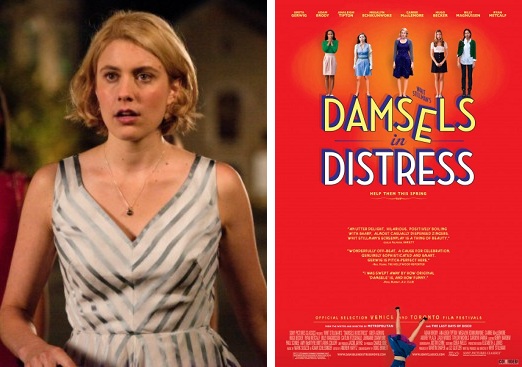
 When writer-director Whit Stillman’s smart, wry Metropolitan appeared in 1990 it heralded the arrival of a fresh, new cinematic voice.
Stillman continued to mine his favorite topic–the comedic hand-wringing and navel-gazing angst of the “urban haute bourgeoisie“–in Barcelona (1994) and The Last Days of Disco (1998).
But then the film maker dropped off the indie-cinema map, moving to Paris for a decade, where he worked on several scripts, wrote a novel version of Disco, but did not make any new films.
Until now. Stillman is back in art-house theaters this month with Damsels in Distress, which despite the 14-year layoff, should feel delightfully familiar to the film maker’s fans: Young people (this time at an East Coast university) struggle amusingly to make their ideals fit the social-cultural realities of the world around them–and vice-versa.
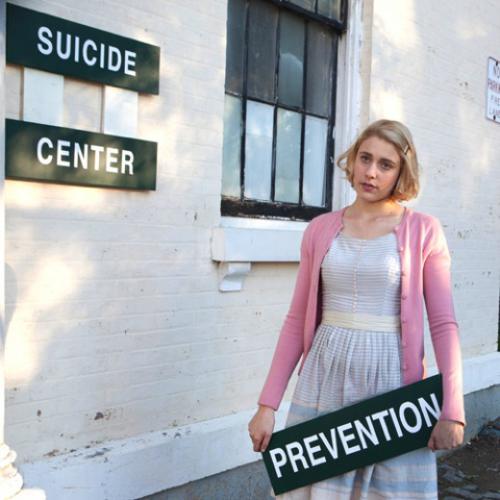
Damsels stars current indie darling (and mumblecore pin-up) Greta Gerwig as Violet, a standards-obsessed upperclassman who strives to elevate the cultural, philosophical, and moral behavior of her less-high-minded classmates through suicide prevention programs, dating “losers,” and working to create a new international dance craze that will unite people of all socioeconomic types.
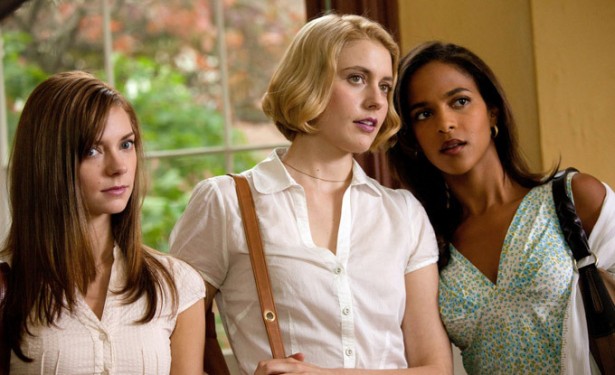 During the course of the film, Violet and her cohorts (Carrie MacLemore and Megalyn Echikunwoke) turn their “helpful” attention to an incoming freshman (Analeigh Tipton), but soon all four young women find themselves entangled with suitors of varied worth and character (including Adam Brody).
All of it, of course, is told with Stillman’s trademark ear for archly witty dialog and heart-felt affection for his sophisticatedly misguided and naive characters.
Gerwig herself has been gaining more attention in recent years, both in indie films like Greenberg and House of the Devil, and mainstream comedies like last year’s No Strings Attached and Arthur remake.
I and another writer sat down with her last month in Chicago to talk about Damsels and Violet, working with Stillman, finding a character through how she runs, and how to survive a press tour.
Damsels in Distress is expanding to select theaters this weekend.
_____
Were you familiar with Whit Stillman’s work prior to Damsels?
Greta Gerwig: Yeah, I loved it. The first thing I saw was Last Days of Disco, because that came out in ’98 when I was a freshman in high school. I was too young to see it in theaters then, but I did see it later in high school, and then in college I watched the rest of them. I loved them–they were so quotable, and my friends and I used to do Chloë Sevigny’s Last Days of Disco dance at parties. It’s like a really subtle dance, but it’s great.
 So Whit was iconic for me–he was on a list of film makers that I’d given my agents and said I’d do anything for these film makers. If they call, you answer.
I heard a horror story that Quentin Tarantino had been trying to get James Woods for Reservoir Dogs or something, and Woods’ agents had never passed on the information. And Woods saw Reservoir Dogs at Cannes and went up to Tarantino and was like, “Oh my god, I’d be in any movie that you do,” and Quentin said, “Are you serious? I tried to contact you for two years.” Then Woods fired his agent. So I tell my agents, “Please pass everything on to me, I don’t care what it is.”
Were you worried the character of Violet and Stillman’s arch dialogue might overpower the film?
Gerwig: I wasn’t really worried because I had such trust in Whit as a film maker–I knew that whatever my performance was would be in service of his vision. I love very much giving myself over to a film maker and going with whatever they like–it’s one of the biggest pleasures because you get to surrender to what their vision is and what their peculiar world view is. But I never worried about the performances being overpowering because I knew that was his gift, that he could give people these words and this kind of heightened language and yet make things that were deeply felt and were incredibly watchable.
 Violet is such a fascinating character, and different than the types you’ve played before. Was her character challenging for you?
Gerwig: In a funny way, she is different than ones I’ve played before, but I had this little spark. Not every movie and not every part is like this, you don’t always feel like, “Oh, I know what I’m going to do with it.”
I actually did feel that with House of The Devil. I just had an image of her eating in a gross way, and [House director] Ti West and I talked about it, and I just knew what I wanted to do with her. And on Damsels I had that spark, and when you do and it comes from a genuine place, it doesn’t ever feel like work. When you don’t have that spark, it feels like “I’m making decisions here” in an artificial way, and you’re just adding things on top of something.
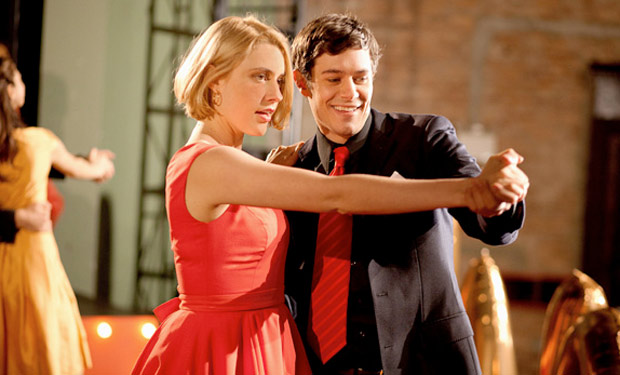
It comes from little things–I knew how I wanted Violet to run. I wanted her to run with her arms at her sides and taking baby steps. It was just this image of her doing that, and I wanted her to dance in a dorky way. I thought it would be fun. Chloe has such a distinctive way of dancing in Last Days of Disco and she looks so cool doing it, and I thought, “Violet’s not cool, Violet is like a puppy dog,” and she has to dance like a teenage girl with a crush.
What’s fascinating is Violet’s so self-invented but she’s invented herself in all these odd ways.
Gerwig: She’s so sincere as a character, but also she’s an incredible liar. She just makes stuff up, but it comes from a sincere desire to connect with people, so she’ll just say whatever she needs to say to get to that point. In Whit’s mind there’s a difference between telling an untruth and being insincere—to him it’s much worse to be insincere. You can be sincere and be telling lies.
Violet lies to support her own ideology.
Gerwig: Exactly, but she’s open to being wrong–she’s also a glutton for criticism.
 What’s the distress these damsels are in?
Gerwig: I see the movie through Violet’s eyes, and her distress is the world is bumping up against her ideals. She wants things to be a certain way, but she can’t help but falling in love with liars. She wants to control everything but she can’t, so her distress is how does she square that?
It seems Violet’s self-invention has a lot in common with acting. And these press tours also have an element of it.
Gerwig: It’s true, I do feel like I’m in costume on press tours like this. I have stylists who dress me, so I don’t ever wear my own clothes. But it helps because it makes it seem like you’re preforming the role of someone who’s being interviewed.
The past couple of years, with Arthur and No Strings Attached, you’ve had to do more of the big press tours.
Gerwig: You get more used to it, you get better at it. I remember the first time I did a press junket the camera and sound guys filming the interviews were saying, “You have to stop actually answering the questions–they’re not listening to you, they don’t care what you say.” Because I was really trying to answer each question differently and the crew were getting tired of listening to me.
That must drive you a little crazy to enter into a process where feel a more like a commodity.
Gerwig: It’s definitely more like you’re a cog in a machine– the media folks are putting together their news magazine or whatever, and you feel like you’re filling this slot. It feels more like you’ve gotta give them their sound bite. But I just started to think of it like any job that I’ve done–it’s like the paperwork. Every job has paperwork, and it’s part of it, and it might not be your favorite part of the job, but it does help everything run well and it does help people sell the movie. So yes it makes me feel a little bit like a machine ,but also it could be worse.
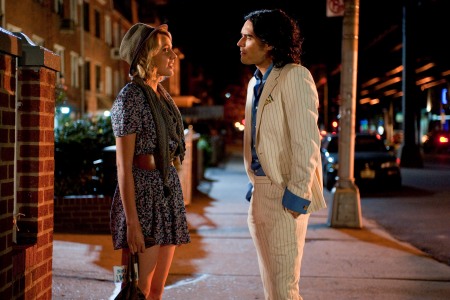 What’s the big difference for you between filming something like Damsels and something like Arthur?
Gerwig: In a certain way they’re not dissimilar once the cameras are rolling. In any film, regardless of the budget or whether or not the people involved are famous or notable, acting feels like acting to me.
I guess the big difference is when you make something for almost no money–like Whit didn’t have a large budget for this–you have more freedom. No one’s looking over your shoulder, so there’s always the potential to make something quite peculiar and different.
Martin Shafer and Liz Glotzer at Castle Rock basically wrote Whit a check–a small check–and said, “Go make your movie.” So there wasn’t a lot of “betting” on Damsels–it wasn’t this huge process. Whereas with No Strings Attached and Arthur, they tested those movies a lot, so you knew how people would feel about it. Those film makers are good at making movies that aren’t jarring, so when you watch them you expect something, and they deliver on that. Whit doesn’t have to do that.
As part of a newer generation of actors, do you feel pressure to go in a more mainstream direction versus independent films like this?
Gerwig: I don’t really feel pressure to go in any particular way. The truth is–and I don’t mean this despairingly about actors–someone will always be there to fill your spot. There’s no shortage of talented, pretty girls–it’s not like anyone’s going to miss me if I decide to not do that. I watch Chloë Sevigny’s career, the choices she made and the film makers she chose to support. Tilda Swinton is very much like that–she really goes out of her way to work with interesting film makers. So does Carey Mulligan.
 I do think you’re only as good as the film you’re in. You can give a great performance in a bad film, and it doesn’t really matter. To be good and get better, you have to work with great directors. It’s about always looking for who’s the Peter Bogdanovich of today, or the Mike Nichols, or Francis Ford Coppola. Who are the people who are going to push you?
You have to keep valuing yourself as an actor instead of as a commodity, because film makers are interested in characters and people and actors, they’re not interested in brands.
 Hammer & Thump