 I was late to the Mumblecore bandwagon (or conversely the “anti-Mumblecore” counter-bandwagon), so I hadn’t seen a Duplass Brothers film until 2010’s oddly sweet Cyrus completely snuck up on me and on repeated viewings become one of my favorite films of the year.
Cyrus, which stars John C. Reilly as a lovable loser falling for Marisa Tomei and Jonah Hill as her passive-aggressively possessive son, was the first major-studio work from co-writers and directors Jay and Mark Duplass, whose films The Puffy Chair (2005) and Baghead (2008) helped shape the mid-‘00s independent genre.
(Defined by their low-budget, small-drama naturalism, “Mumblecore” films usually focus on post-college characters comically and/or bittersweetly adrift amidst their relationships and careers.)
The Duplass Brothers’ latest work, Jeff Who Lives at Home, follows Jason Segal’s Jeff, a 30-something who, as the title suggests, lives in his mother’s basement where he smokes pot and watches M. Night Shyamalan’s Signs. The 2002 Mel Gibson sci-fi flick has Jeff convinced that the Universe has a special fate in store for him, he just has to watch for the signs that will point him to it.
 On a seemingly average day for Jeff, his guileless openness to an unknown destiny sends him on a riotous trek around Baton Rouge with his much more aggro-assertive (that is to say, asinine) brother—a terrifically out-of-type Ed Helms who’s dealing with the possible infidelity of his wife (Judy Greer). Meanwhile, the brothers’ mother, Susan Sarandon, faces her own mini-journey of discovery thanks to a secret admirer at her office.
As with Cyrus, Jeff gets better each time I see it, so I was thrilled to sit down last fall with Jay Duplass at the Chicago International Film Festival. We talked about Jeff Who Lives at Home and its excellent cast, the Duplass Brothers’ idea of “epically small” personal drama, and the rowdy fans of Mark’s profane cable-TV sit-com The League.
____
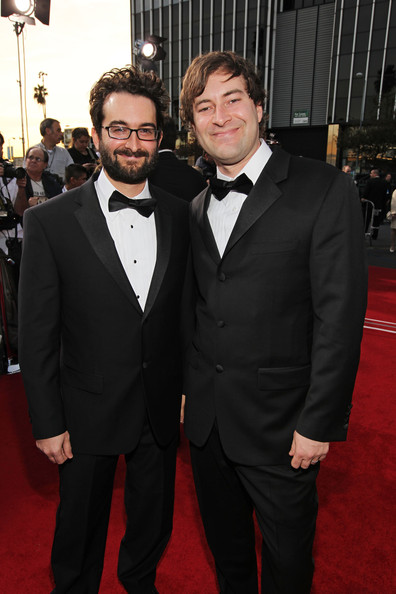 I met you in passing last winter at the Critics’ Choice Awards, but we didn’t get a chance to talk because you, Mark, and (Mark’s wife and co-star) Katie (Aselton) were introduced as “the Guys from The League,” which at the time I wasn’t watching. So I didn’t instantly make the connection with Cyrus, which I really loved.
Jay Duplass: We’re The Artist’s Formerly Known as The Duplass Brothers, now Known as the Guys from The League—which I have no affiliation with personally. [Mark co-stars in The League, but does not write or direct it. Jay is not involved its production in any way.] But there is a certain demographic of fan that is The League fan. Mark and I are standing on a street corner somewhere, and some 20-year-old pulls up in a Mustang and yells, “The League fucking rules!” And he just screams on the top of his lungs, scares himself as much as us, and he moves on. It’s a very spirited group.
So how would you describe your style of film making to someone who’s never seen a Duplass Brothers’ movie?
Duplass: I think we tackle very common issues. With Cyrus in particular, it’s almost a sit-com: A divorced guy doesn’t think he’s going to make it in life, and meets this woman, and it turns out she has this son and he eventually realizes that he is in competition with this son for this woman’s attentions.
But I think we have a sense of intense naturalism–we shoot documentary style and look for acting that is even an extra step above what feels and looks real. But we also employ comedy, and lately we’ve been talking about finding the subtlest form of a joke or emotional interaction. We’re threading needles as to how to make it as subtle as possible.
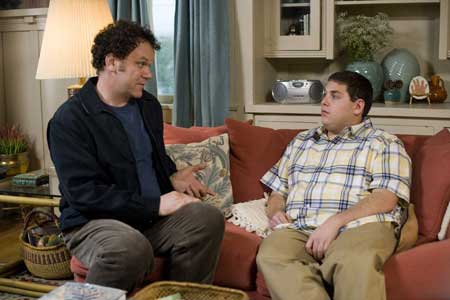 Sit-coms became popular because they were based on familiar everyday situations, hence the name. But now you’re stealing those familiar “sit-com” plots back.
Duplass: We’re middle class kids who grew up in the suburbs of New Orleans and didn’t really have any intense problems–we didn’t face anything epic, everything was pretty comfortable for us. So the majority of our problems came from within our families and within our friendships and our relationships. For a long time, at the beginning of our career, we made terrible movies because we were being referential to other people. We were trying to make things we thought we should make and that’s not really what we’re dealing with on a regular basis.
But then we started making fun of ourselves and the stupid stuff that we were going through on a daily basis, and how intensely dramatic it felt. We thought when we were putting that stuff out there that people would just laugh, but we got such a surprise when people went along for the dramatic ride. It doesn’t matter that the worst thing that happened in most of our films was that somebody who loves somebody else hurts their feelings really bad and they’re not sure if they’re going to be able to be with that person again. The dramatic bar, I have found, is the same. Mark and I talk about it as the “epically small”–all this small stuff that’s going on that feels so epic when you’re in the middle of it.
 It’s interesting how you learn about yourself talking about the film. Most of the time we’re off in a cave making the art, but when you get out and start talking about it with people, you realize, “Oh yeah, our movies are about family and how difficult relationships are.” Jeff Who Lives at Home is really about a group of people who happen to be in the same family, but aren’t very united at all and who are all kind of in a shit place in life and trying to get to some place better. And they all seem to have very low skill levels in achieving that, but on this one particular day magic comes into the equation.
This is the first of your films that really plays with the sort of “magic realism” or coincidence that’s pretty common in regular Hollywood films. Going into the process, was that a conscious decision or did it just sneak in there during the writing?
Duplass: For Jeff Who Lives at Home we were able to branch into magical realism because the lead character believes in magical realism–he believes in destiny and the concept of the universe conspiring in your favor. So that was our entry into it, through the eyes of the lead character, and of course his entry into it is through Signs. Everyone’s like, “You guys must love the movie Signs?” and we thought it was interesting, but if you’ve seen our films it’s not really our cup of tea. But we love guys who love the movie Signs and regard it as this epic, monumental work of art that could be used as a compass as to how to live your life. That is really funny and kind of exciting to play with.
 Your lead characters in Cyrus and Jeff share a certain mix of sweetness and a sort of unpredictable edge. They’re good-hearted, but you feel like they could believably snap.
Duplass: That’s something that goes back to the documentary and realism–we’re just obsessed with real, regular people. Regular people are really fascinating and interesting because they do have all these dimensions to them. It’s hard for me sometimes when I see the best-looking dude in the world in a film where he can’t get the girl, and I’m thinking, “Dude, you don’t have the problems that average dudes have–you probably don’t know what it’s like to get rejected by 20 girls in a row.”
I know everyone suspends disbelief for a movie, but what we’re trying to do is force you to suspend a lot less disbelief so that when things are happening they feel very, very real. That’s what allows us to keep the dramatic bar low. When something really emotional or difficult happens to somebody in one of our movies hopefully you feel so connected and feel that situation is close to real, that it means much more to you–it just feels like it would if it happened to you.
You got terrific on-screen matches in Cyrus with John C. Reilly and Jonah Hill and now in Jeff with Jason Segal and Ed Helms. When you’re writing these roles is there a type of actor you’re thinking of?

Duplass: We didn’t think so, but now that I look at John and Jonah and Ed and Jason, obviously we really like normal dudes who are really funny. We tend to pull from Apatow’s world a little because those guys are very comfortable with improv and we’re improvising every single take.
But also those four guys in particular understand that sadness and humor are not mutually exclusive, in fact they are tied together. Mark and I always talk about the tragic funny—we’re obsessed with tragic characters that are hilarious. We were trying to be the Coen brothers forever, but then Mark and I started exploring the conversations where we were usually talking about these really painfully embarrassing things that our friends were doing, and we would cringe about the drama of it all, and then five seconds later we’d start giggling.
If you look at the character of Jeff at face value he’s really a sad dude. He’s living in his mom’s basement, and he’s waiting for the universe to tell him what to do, but he’s really just smoking pot all day thinking about stuff and not doing anything. But there’s something really earnest and hopeful and genuine and funny and sweet about him too, and Jason, in that particular case, knows how to embody it–he sees the humor and the sadness in the character at the same time. There’s definitely a lot more goodness in Jeff, in particular, then in characters in the previous films–there’s a lot more hopefulness and a lot less passive aggressive behavior.

He and Ed Helms create such a powerful brother dynamic on screen. They’re completely at odds with one another, but you really feel like they’re siblings.
Duplass: I think Mark and I are obsessed with brothers. We’re married guys, we both have daughters, we’re close with our parents, and we’re the only siblings, so we work together and we’re very close and it’s almost another marriage. It’s a lot of work to manage that relationship and not in a bad way. But it’s so intense because you have so much at stake with brothers and you can’t get rid of each other–that dude’s always going to be there, he’s going to be there every weekend.
For Jeff, we wanted to create two brothers who literally could not be more different from each other and are stuck, joined at the hip, at least on this day–the movie takes place in the course of a day–and how they manage each other and how they deal with each other. There’s something really special and painful and sad and hilarious about how brothers deal with each other.
And Helms is playing so completely against the sweet, naive type he’s established in The Office, The Hangover films, and Cedar Rapids.
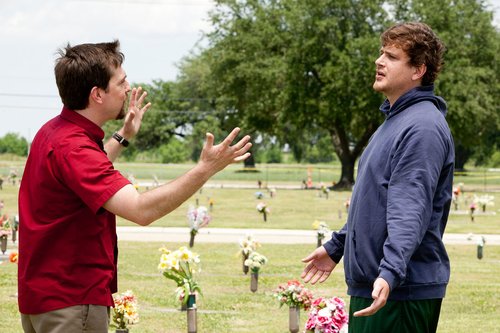 Duplass: We do like to play against type a lot–it’s something we did with Jonah in Cyrus, something we did with Ed, and something a little bit we did with John in Cyrus, too. We knew Ed a little and knew that he had some edge to him, and there’s a lot of emotional depth that we were just really interested in mining.
A lot of what we’re doing in our movies, we’re trying to guide you as much as we can and still keep you guessing. I feel like no matter what genre our movies are in, there’s always a sense of mystery to them, and particularly with the characters and what it is they’re trying to do and how they’re going to show up when it really counts. You’re really trying to figure out, “What the hell is he going to do at the end of this thing?”
____
Jeff Who Lives at Home is playing now in theaters across the country.
 Hammer & Thump
One thought on “Interview: Jeff Who Live At Home's Co-writer-director Jay Duplass”